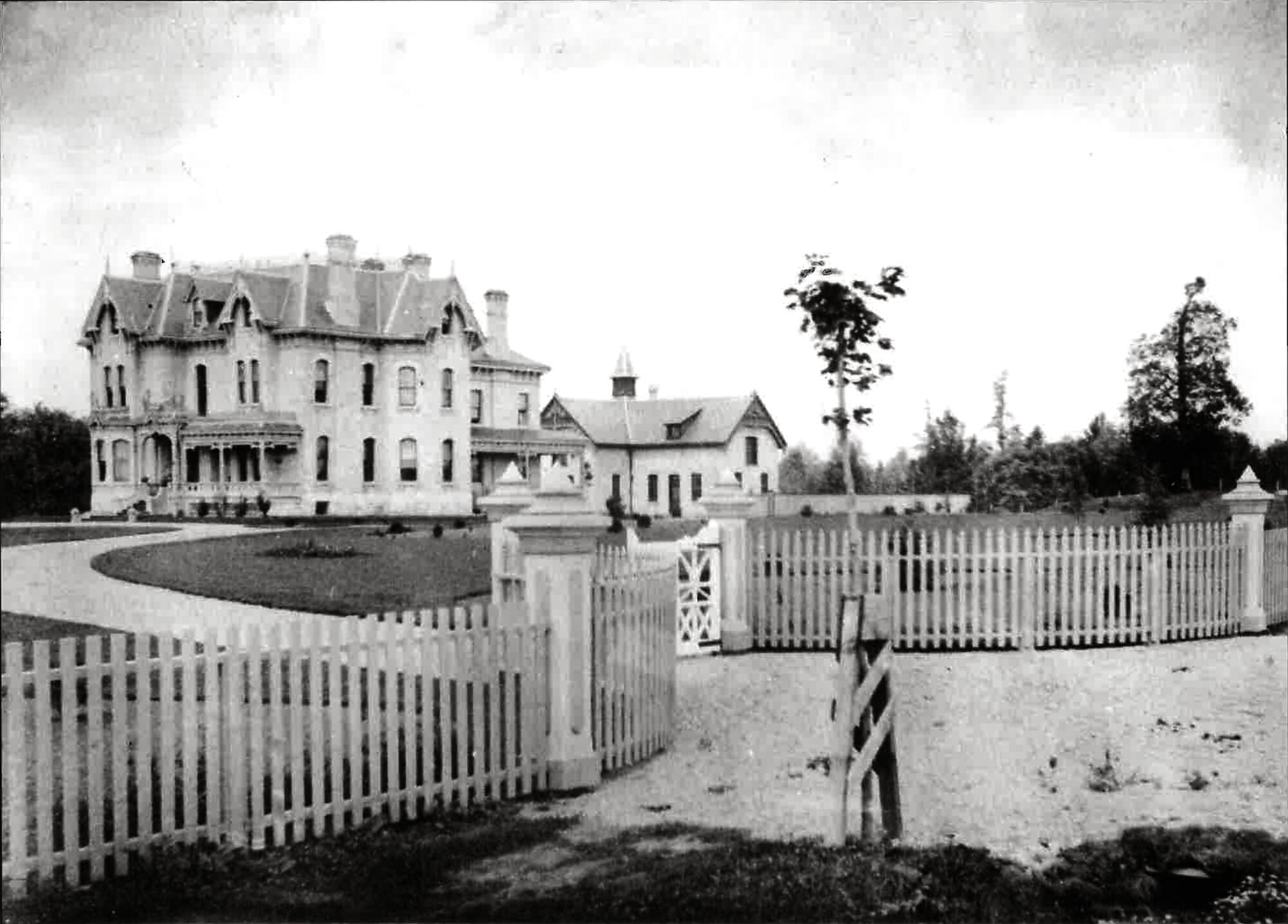
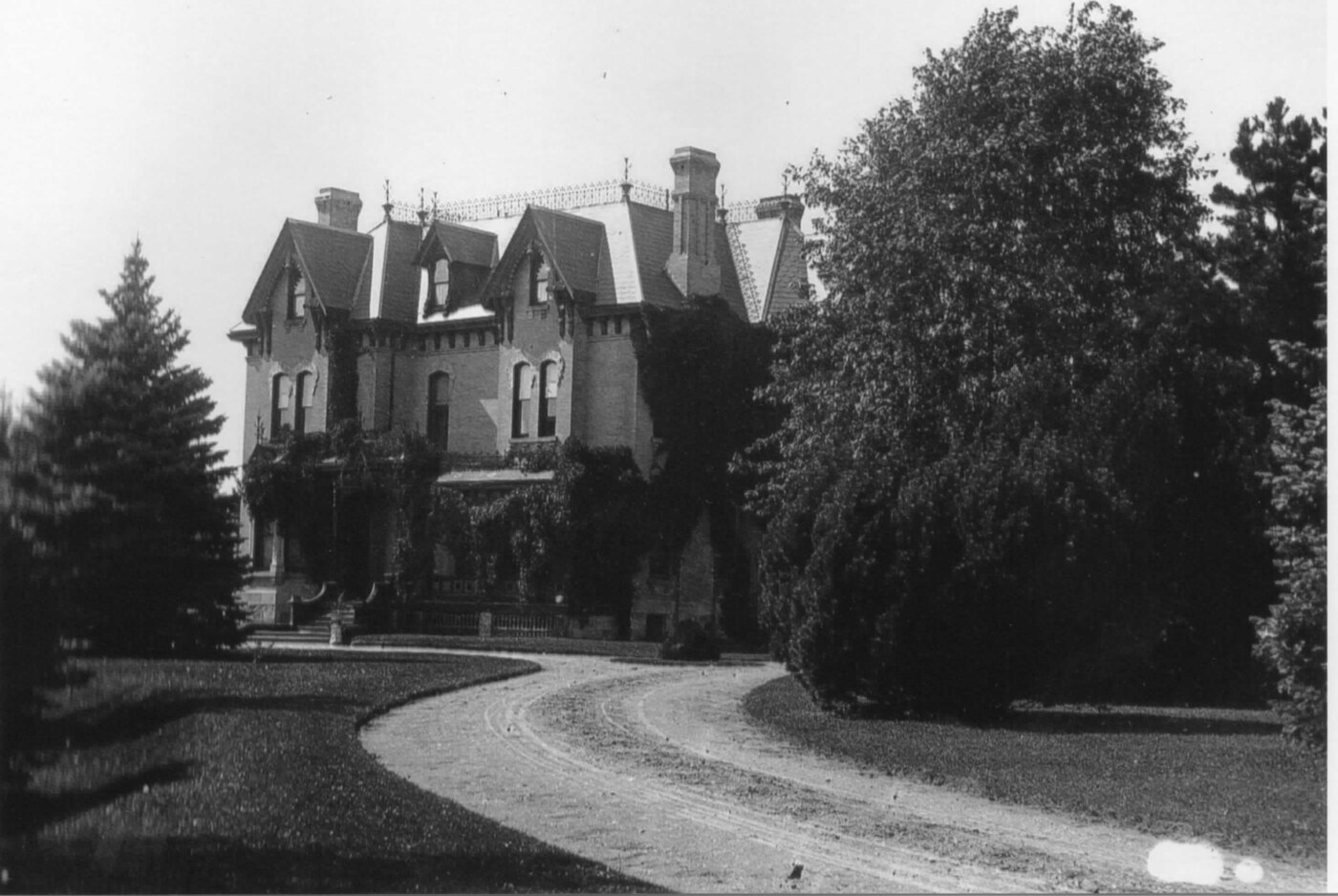
The Gore, circa 1884 — Kitchener Public Library (CHIA, Figure 37)
A heritage of Ayr, Ontario
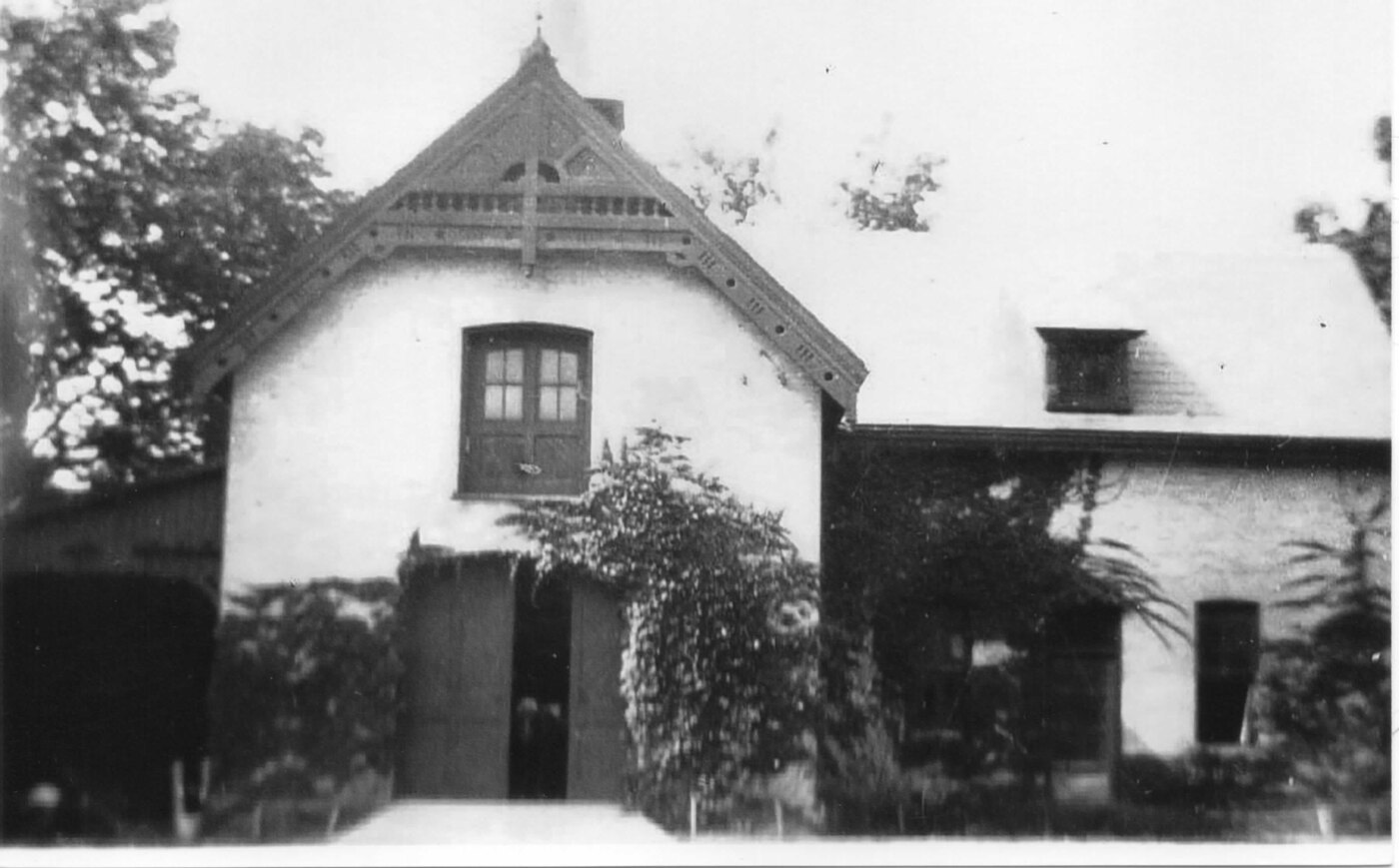
The Gore Coach House
One small building at 5 Gore Estate Court holds the memory of a 21-room Victorian mansion, a pioneering Scottish botanist, a great flour mill, and one of Canada's most important 19th-century foundries.
The building that survived
A coach house outlives its mansion
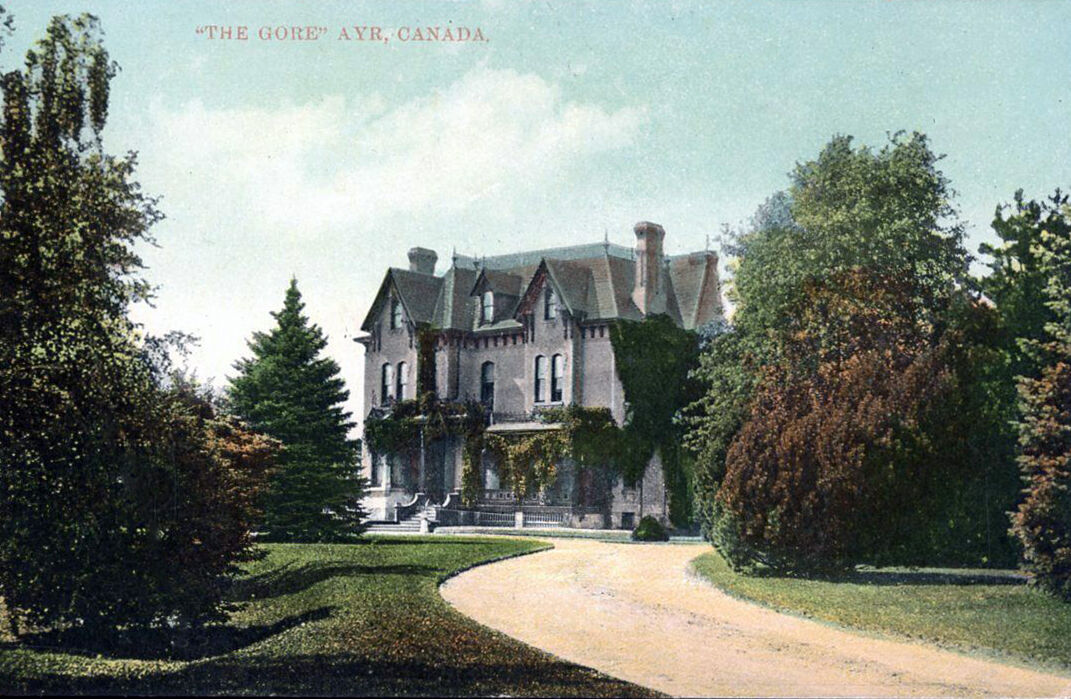
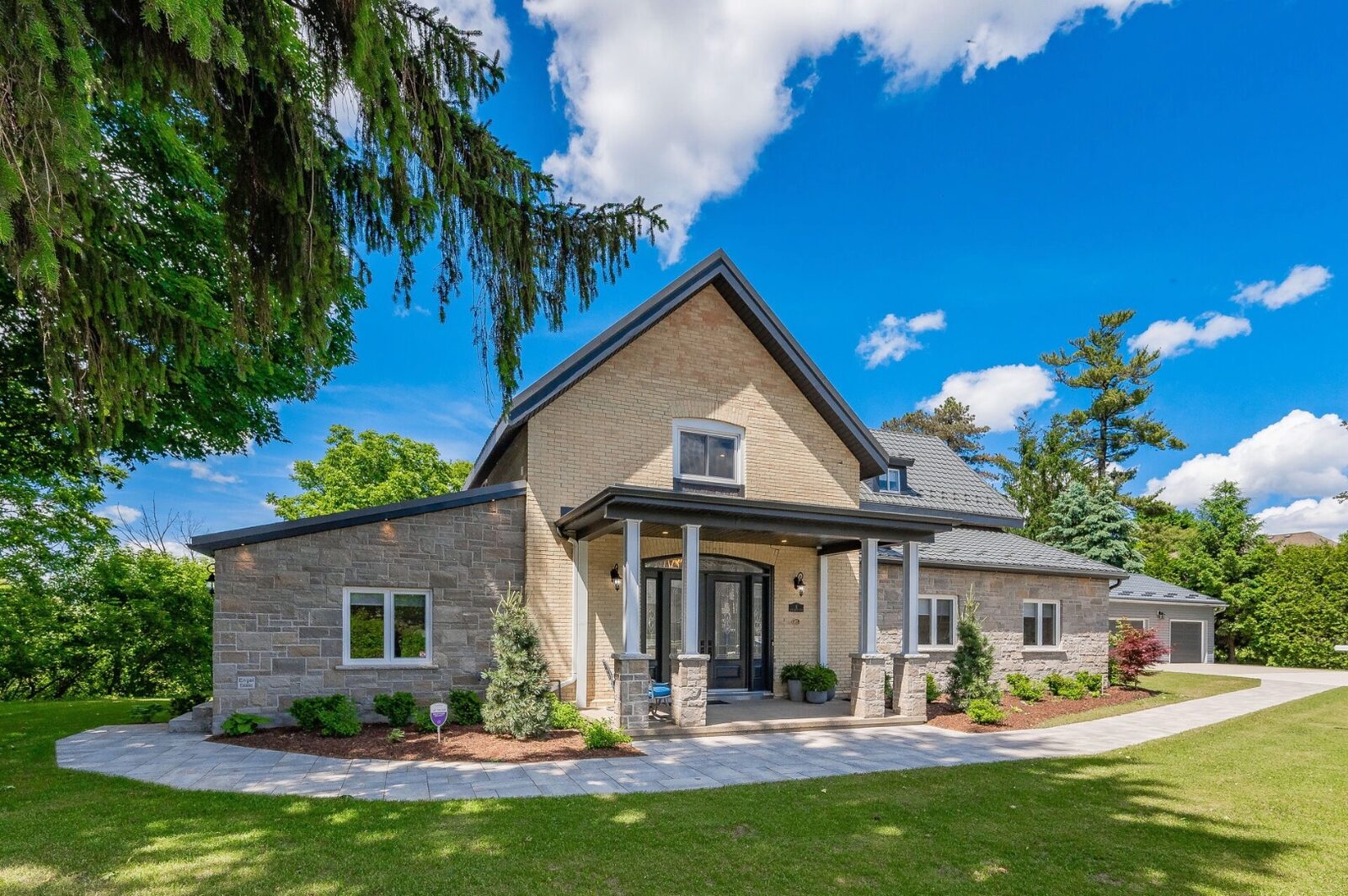
5 Gore Estate Court is the surviving coach house of "The Gore," the grand estate built by the Goldie family between 1882 and 1884 on Northumberland Street. For more than a century the coach house — once at 280 Northumberland Street, beside the mansion at 266 — stood in the shadow of a towering white-brick house. When that house was finally lost — demolished around 2017 to make way for the Gore Estate subdivision — the humble coach house remained.
In 2021, the Township of North Dumfries recognized its importance, designating the building under Part IV of the Ontario Heritage Act through By-law 3212-12: "Designate the Gore Coach House, 5 Gore Estate Court." Today it is a protected reminder of one of the most consequential families ever to settle in the Ayr area.
"To understand this one small building, you have to follow a family from the gardens of Scotland to the foundries of Galt — and to the edge of space."The story of the Goldies of Ayr
The Goldies
A Scottish family that shaped a region
From a botanist who walked thousands of miles across early North America to industrialists whose machines powered a nation — the Goldie name runs through botany, milling, and heavy industry.
John Goldie · 1793–1886
The pioneering botanist
John Goldie was born in Kirkoswald, Ayrshire, Scotland, and trained at the Glasgow Botanic Garden under the renowned botanist Sir William Hooker. Between 1817 and 1819 he undertook ambitious botanical expeditions across early North America, documenting fourteen new plant species — among them Dryopteris goldieana, the fern that still bears his name as "Goldie's fern."
He published his findings in 1822 and later made two collecting journeys to Russia. In 1844 he moved his family to Ayr, Ontario, establishing a farm he named "Greenfield." That name — and that family — would echo through the district for generations.
David Goldie · 1832–1894
The miller who built The Gore
David Goldie, son of the botanist, ran the family's Greenfield mill and became one of Ayr's leading citizens — so respected that he reportedly declined an offered seat in the House of Commons. He married Isabella Goldie, and together they raised a large family.
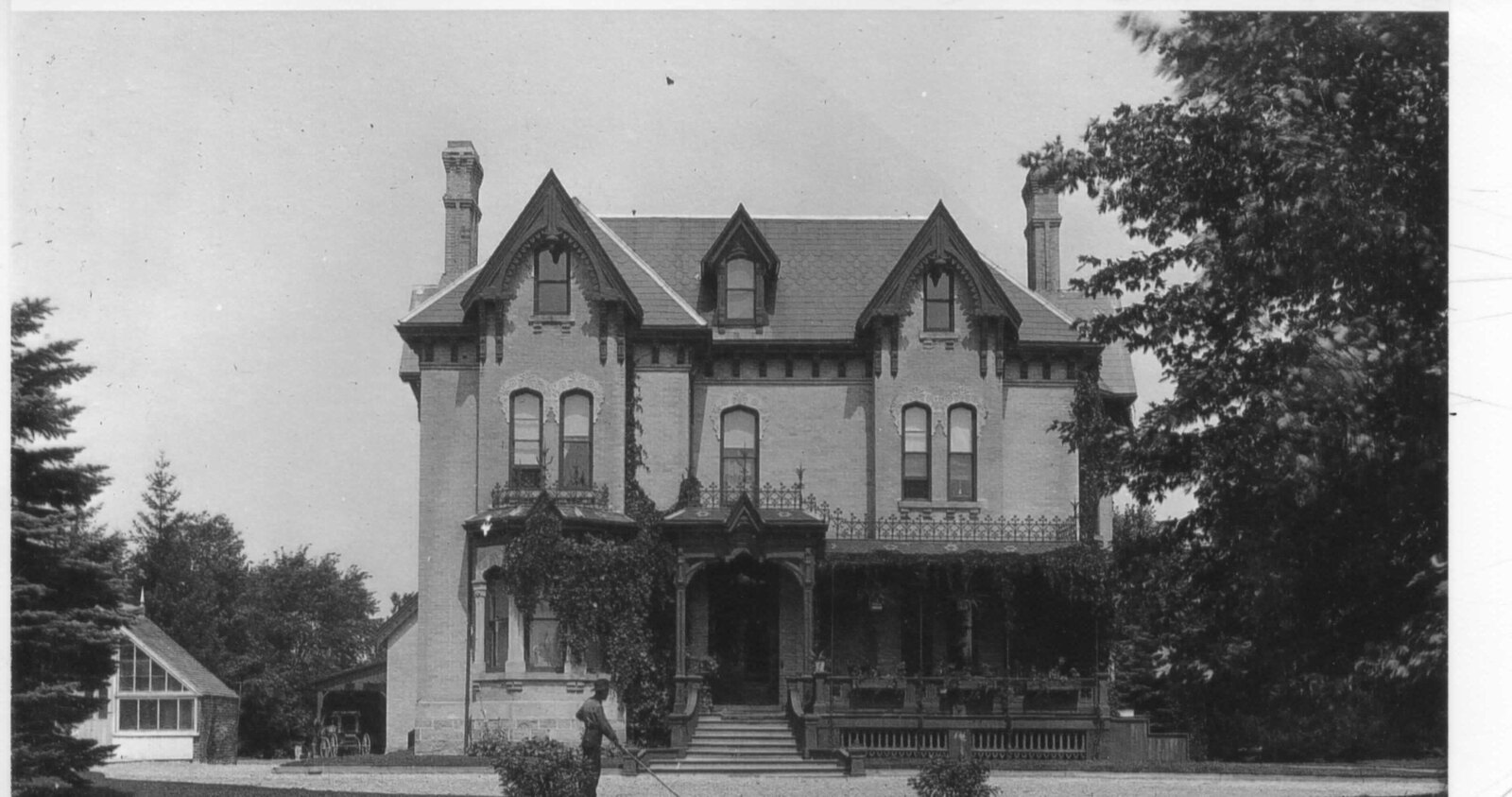
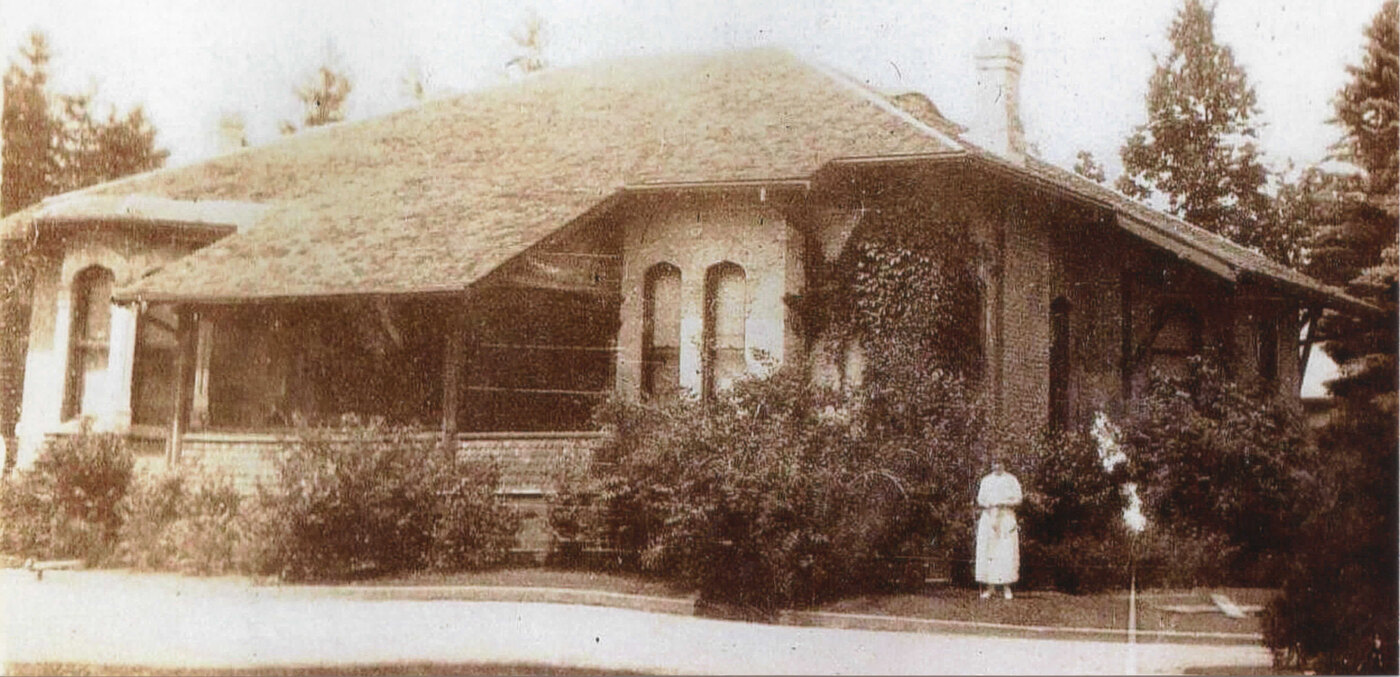
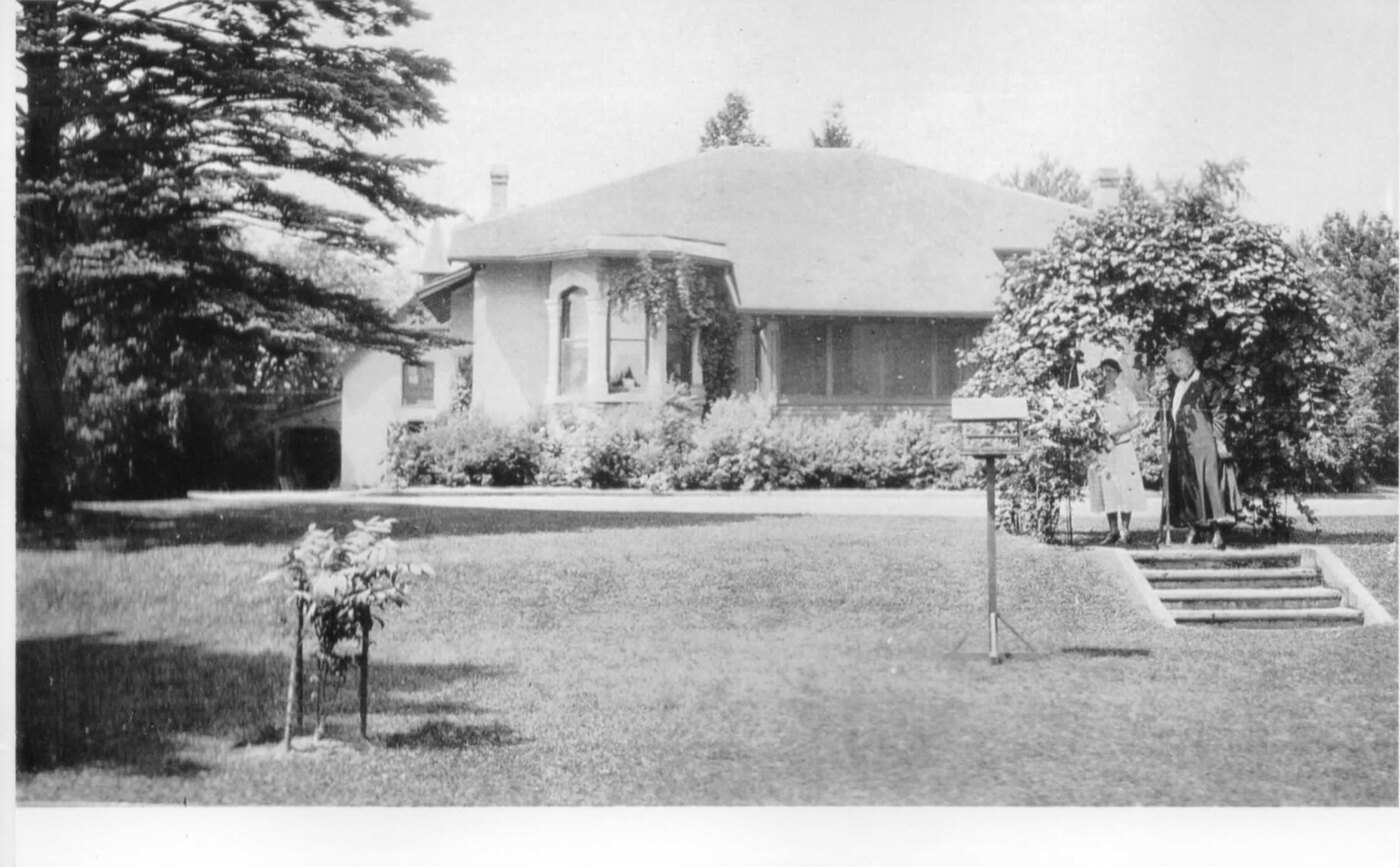
On 21 June 1883 he purchased the Northumberland Street land from John Robson, and by 1884 had completed "The Gore" — a 21-room, two-and-a-half-storey Italianate mansion designed by architect William Mellish (1807–1895), who also built the Waterloo County Court House, for roughly $18,000–$20,000. It rose with a widow's walk and indoor plumbing far ahead of its time. David died in 1894 and the estate passed to his widow, Isabella. In 1922 the house was sold and dramatically reduced — the upper two storeys and half the ground floor were removed, leaving only a single-storey bungalow that survived until its demolition around 2017.

From this family to the edge of space
David Goldie's daughter, Theresa "Tib" Goldie, was the mother of Jim Chamberlin — the legendary engineer behind Canada's Avro Arrow and a key figure at NASA during the Mercury and Gemini programs. He was inducted into Canada's Aviation Hall of Fame in 2001. The same family line that built a mill in Ayr helped put astronauts into orbit.
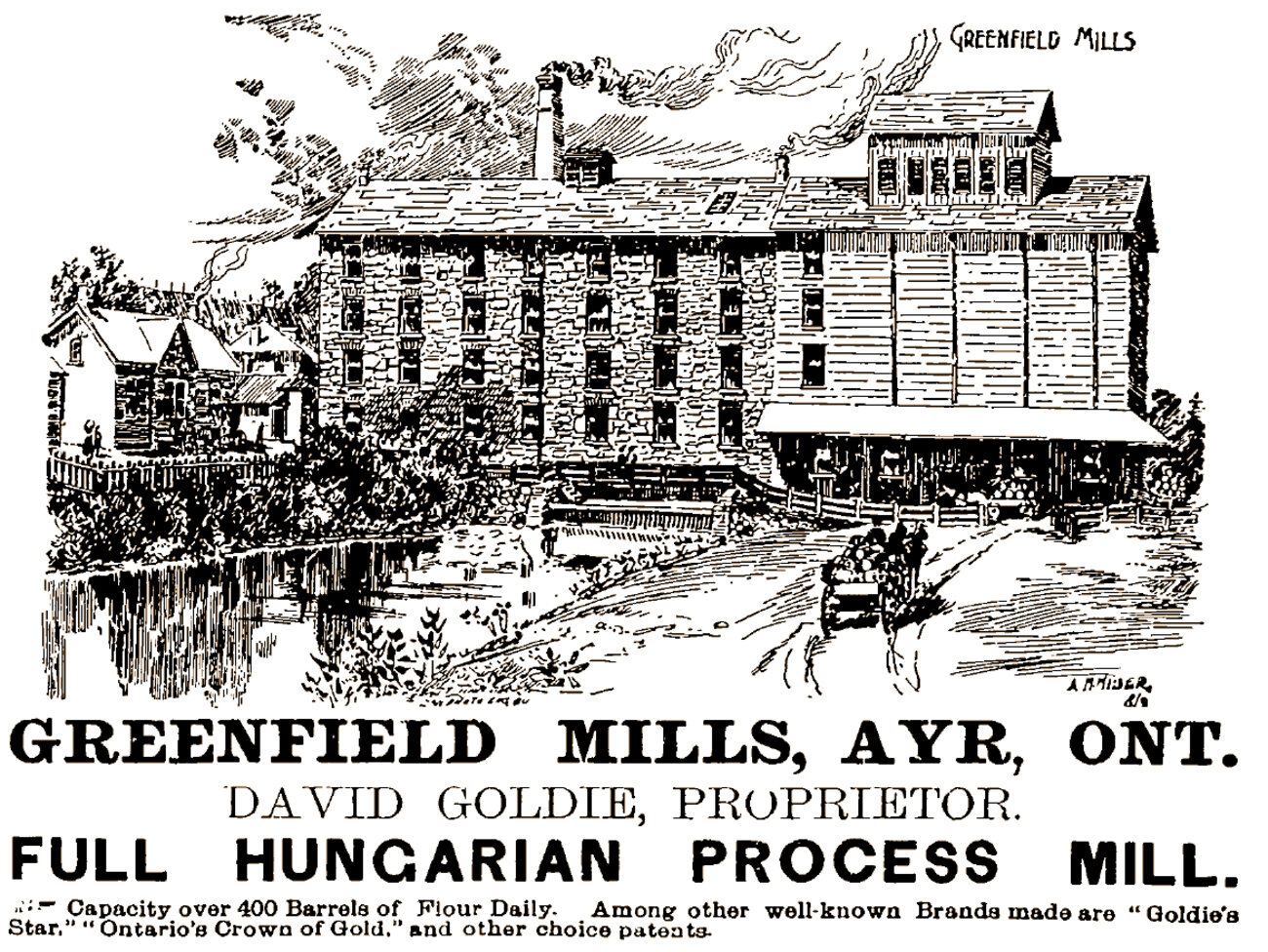
Greenfield Mill
The mill that fed a district — and still stands
Long before The Gore rose on Northumberland Street, the Goldie name was carried by water and grain. The family's Greenfield Mill is where the fortune that built the mansion began — and the building survives today at 3089 Greenfield Road.
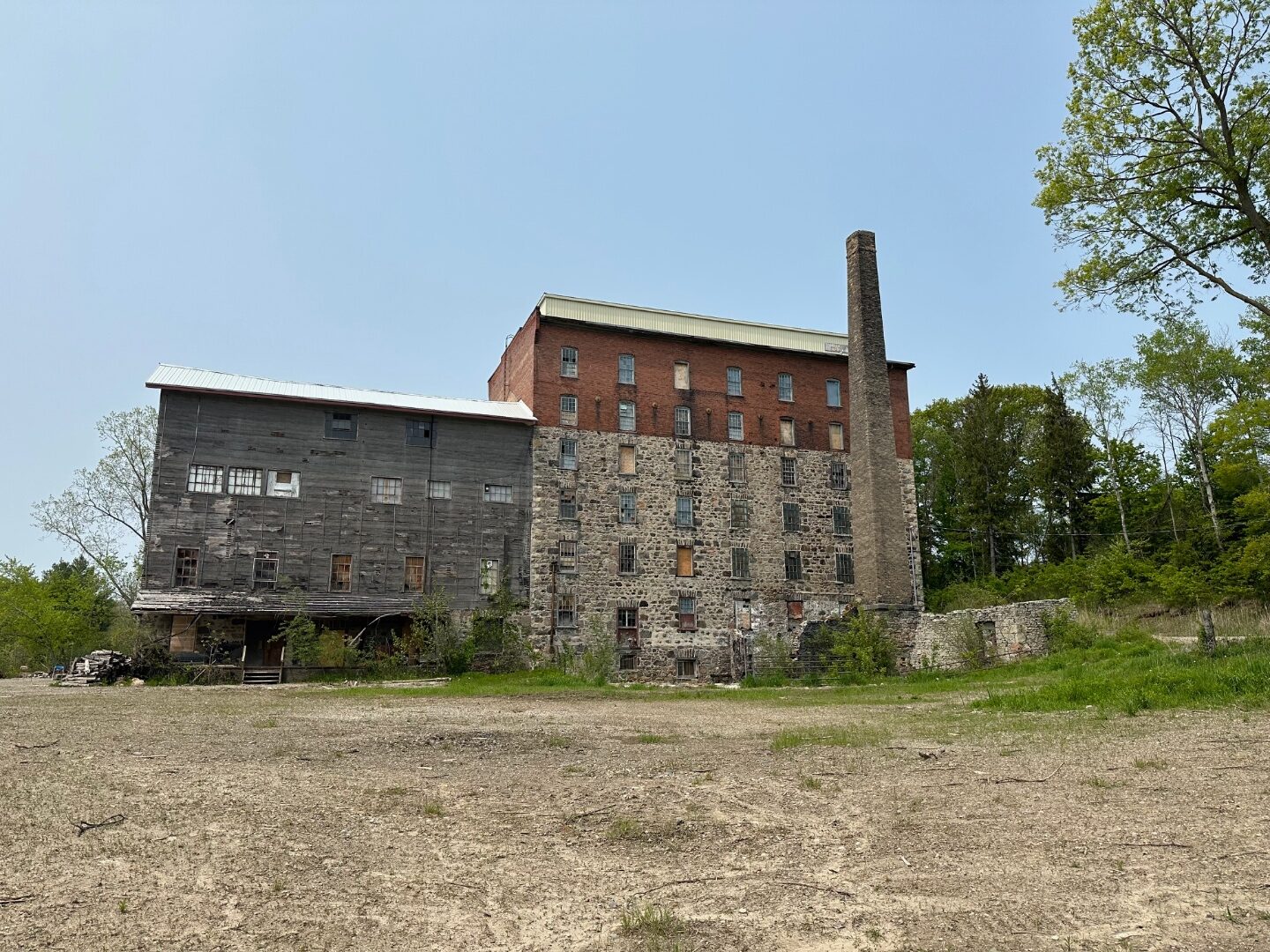
The mill was founded by the botanist John Goldie, with operations beginning in 1850. Water drawn from the Nith River into a mill pond powered the wheels that ground grain into flour and oatmeal for the surrounding district. Under David Goldie it expanded to a capacity of tens of thousands of bushels and became a cornerstone of the local economy.
The Goldie family owned the mill until 1910. It later became part of the Best Foods oatmeal operation before milling ceased around 1964–65. Since 1976 the building has been used by Jad-Vent Distributors for warehousing — a quiet second life for a landmark that gave its name to the whole Greenfield neighbourhood. Goldie also raised a row of five saltbox worker homes nearby to house the mill's hands.
- FounderJohn Goldie
- Operations began1850
- Power sourceNith River mill pond
- Goldie ownershipUntil 1910
- Later useBest Foods oatmeal · closed c. 1964–65
- Address today3089 Greenfield Road, Ayr
The Red Wheel · Goldie & McCulloch Co.
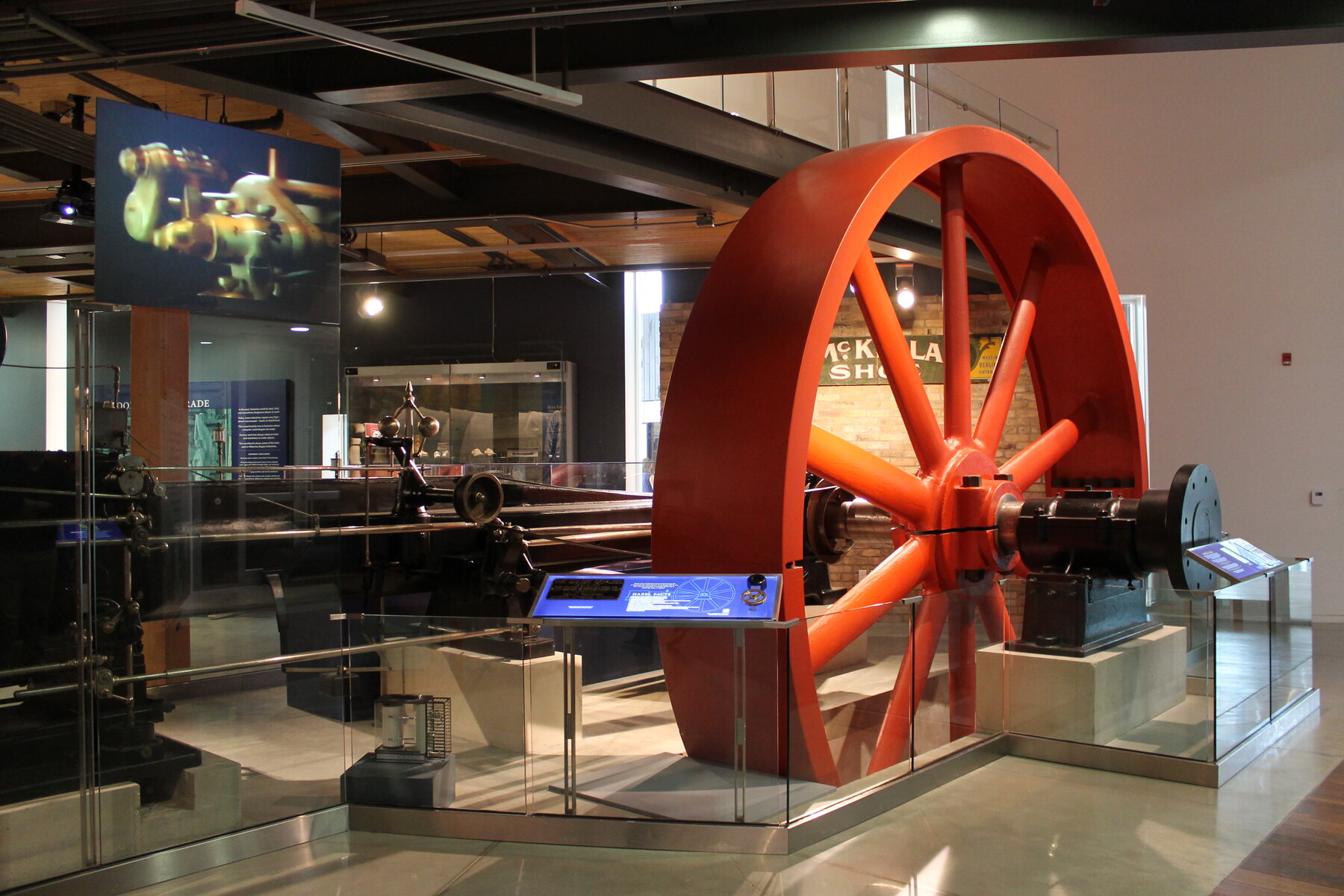
The flywheel at the Waterloo Region Museum
That great red wheel on display at the Waterloo Region Museum is the flywheel of a steam engine built by Goldie & McCulloch — a foundry founded by David Goldie's brother.
In 1859, John Goldie Jr. — brother of David — partnered with Hugh McCulloch to buy the Dumfries Foundry in Galt for $50,000. The new firm made steam engines, boilers, safes, millstones, and woodworking and tannery machinery.
The company grew explosively: from roughly 22 workers in 1859 to about 450 by 1902. It was incorporated as The Goldie & McCulloch Company Limited on April 21, 1891, and in 1883 secured the patent for the celebrated Wheelock steam engine. Absorbed into Babcock-Wilcox in 1923, steam engines continued to be built in Galt under that name until 1987.
The massive flywheel preserved at the museum is a direct survivor of that industrial age — a Goldie & McCulloch engine, painted the deep red that makes it impossible to miss.
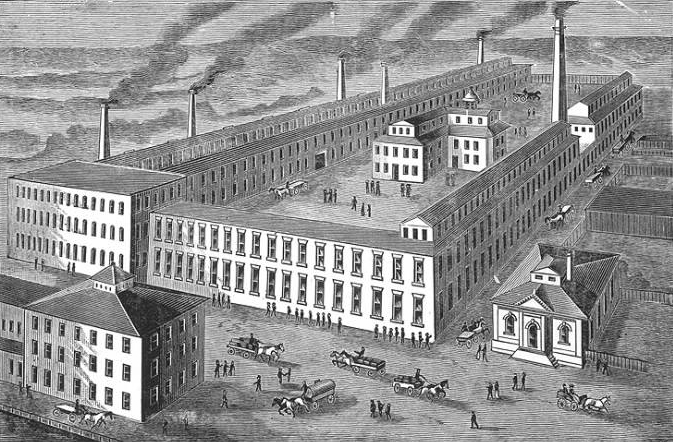
A foundry that built a city
Galt — now part of Cambridge, the same city where Ayr's heritage is administered — became known for the iron and steam machinery that poured out of the Goldie & McCulloch works. Their boilers, safes, and engines went into mills, factories, and vaults across Canada.
Two branches of one Ayrshire family thus shaped the region from opposite ends: David milling grain at Greenfield, and John Jr. casting the machines that powered an industrial age.
Local industrial context
Part of a wider Waterloo County story
The Goldie enterprises did not rise in isolation. They were part of a remarkable cluster of mid-19th-century firms that grew up together as Waterloo County industrialized — several of which still trace their roots to those same years.
In the 1850s, the towns of the county — Berlin (today's Kitchener), Galt and Ayr among them — were transforming from farming settlements into centres of mills, foundries, and machine works. The arrival of the railway, water power, and later hydro-electricity from Niagara drew a generation of millers, ironmongers, and manufacturers who supplied and built upon one another's trades.
Within that same window, the Goldies began Greenfield Mills (1848) and founded Goldie & McCulloch in Galt (1859). They were contemporaries of other firms that helped define the region's industrial character.
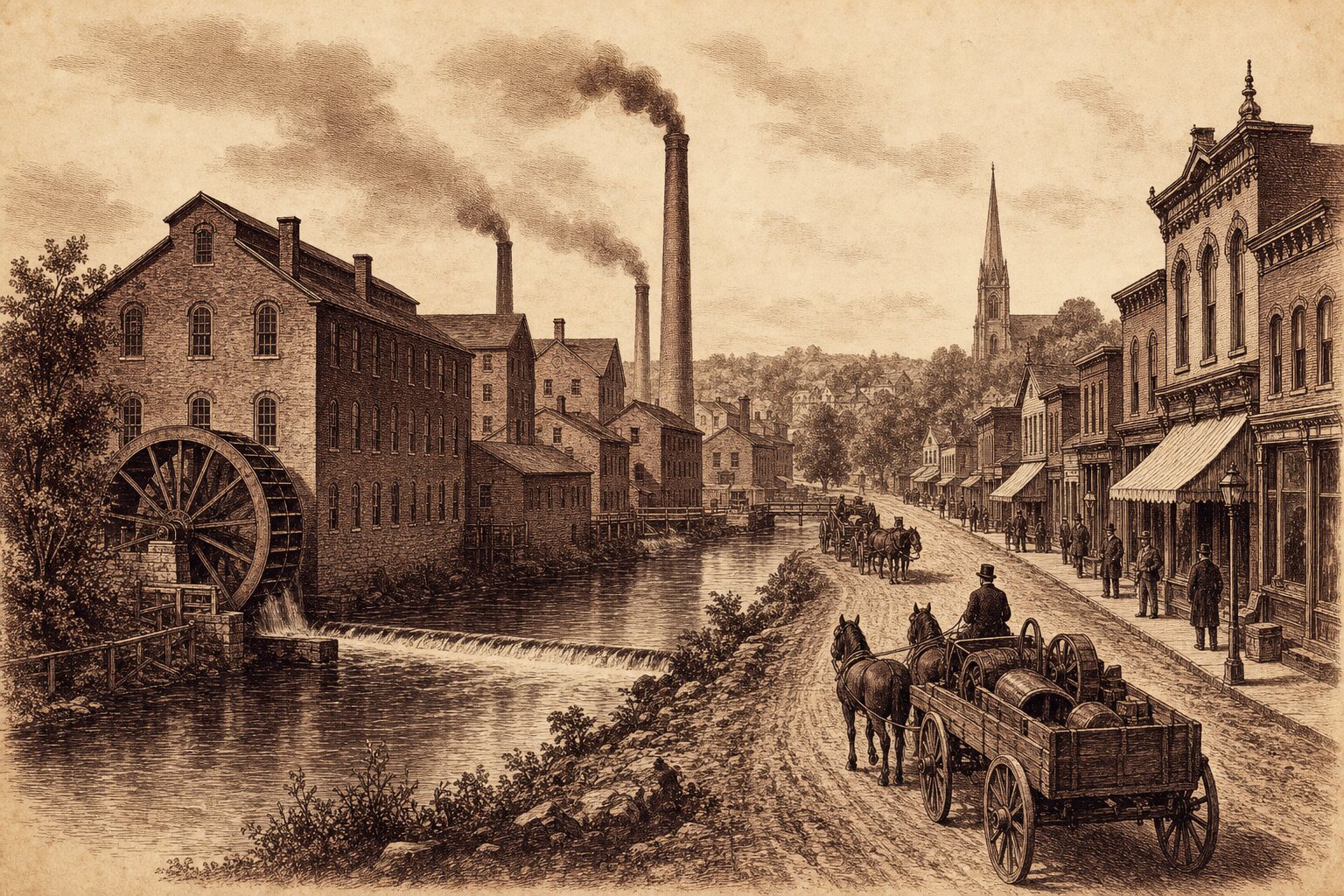
Greenfield Mills
The Goldie family's oatmeal and flour mill at Ayr, later expanded to a 70,000-bushel capacity.
Weber Supply Company
Founded as Date, Distin & Co.A Berlin (today's Kitchener) hardware store opened by Samuel Date, selling iron, steel, tools and carriage-makers' supplies. Through later owners Fennell and Weber it grew into Weber Supply Company — described as Canada's oldest surviving industrial distributor.
Goldie & McCulloch
The Galt foundry and machine works of John Goldie Jr. and Hugh McCulloch — steam engines, boilers, safes and mill machinery.
These firms shared a region, an era, and an industry, but are not known to share any direct corporate or family connection. They are presented here simply as contemporaries that together illustrate the industrial world the Goldies helped build.
A piece of the foundry, brought home
The Goldie & McCulloch gauge lamp
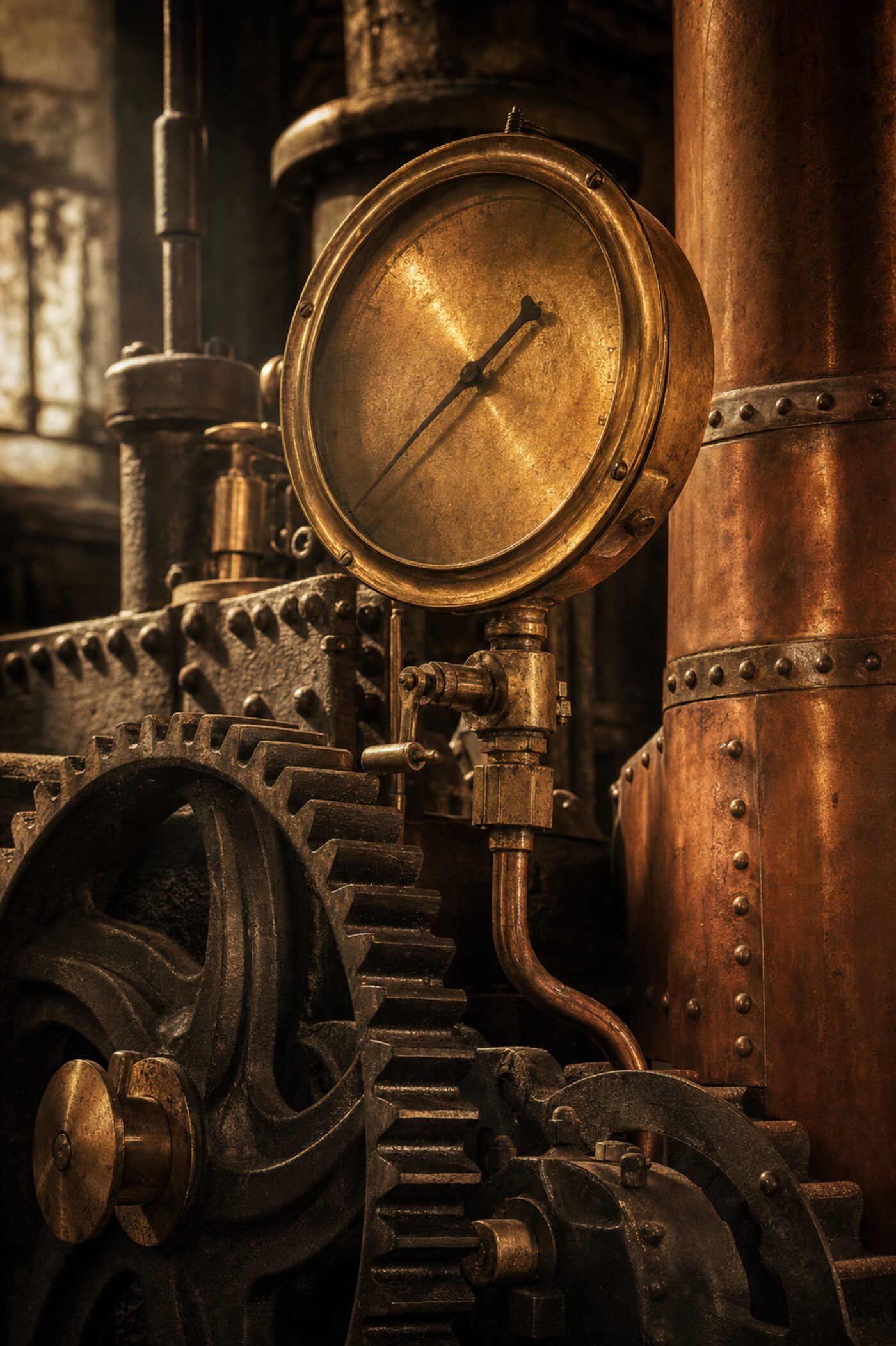
A handmade steampunk lamp built around a genuine antique steam pressure gauge stamped "THE GOLDIE & McCULLOCH Co. LIMITED — GALT, ONT." — a physical fragment of the family's foundry, now part of the coach house's story.
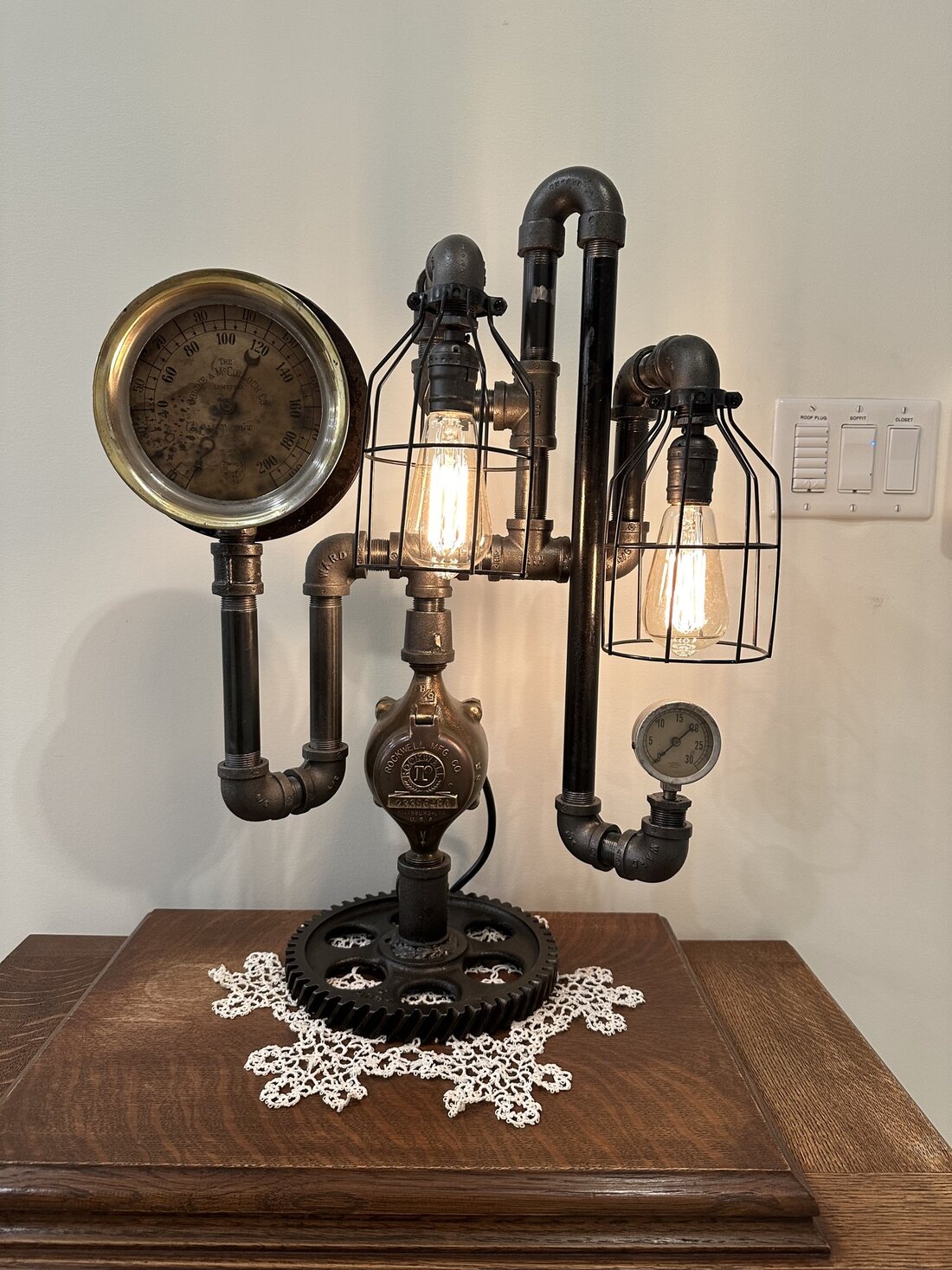
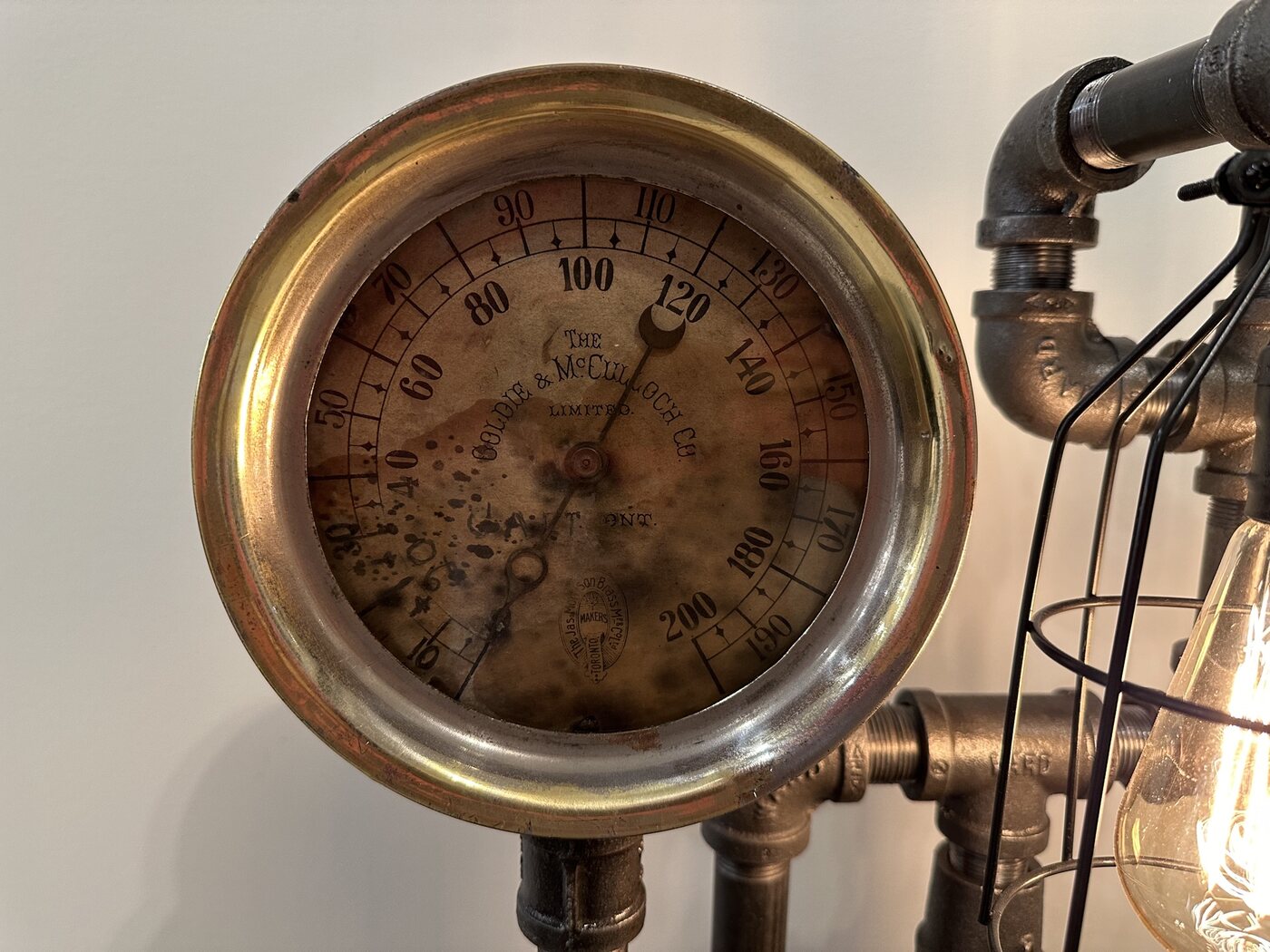
The lamp's centrepiece is an authentic Goldie & McCulloch steam pressure gauge reading to 200 psi. The word "Limited" in the maker's mark dates the gauge to roughly 1891 through the 1920s — the firm's incorporated era. It is mounted with a salvaged Rockwell Mfg. Co. brass valve body and a cast-iron gear base.
It was handmade by Machine Age Lamps, a family workshop in Lakeville, Minnesota that builds one-of-a-kind lighting from genuine salvaged antique parts — never reproductions. Each piece is signed, numbered with a riveted copper ID plate, and wired to UL-listed standards.
- CentrepieceAntique Goldie & McCulloch steam gauge (to 200 psi)
- Era of gaugec. 1891–1920s ("Limited" mark)
- Other partsRockwell brass valve body · cast-iron gear base
- MakerMachine Age Lamps, Lakeville, MN
- ConstructionGenuine salvage · signed & numbered · UL-listed wiring
The estate in pictures
The Gore, then and after
A gathering of the surviving images of The Gore — from the mansion in its full Victorian grandeur, through its dramatic 1922 reduction to a single-storey bungalow, to the coach house that outlasted them all.

The original drawings
How The Gore was designed
The mansion was designed by Brantford architect William Mellish (1807–1895), whose original circa-1884 drawings survive in the property’s Cultural Heritage Impact Assessment. They show a richly detailed Italianate-Gothic residence — paired arched windows, a deep verandah, a conservatory wing, and the fully finished basement of service rooms beneath it all. A later annotated plan records exactly how much of the house was lost in the 1922 reduction.
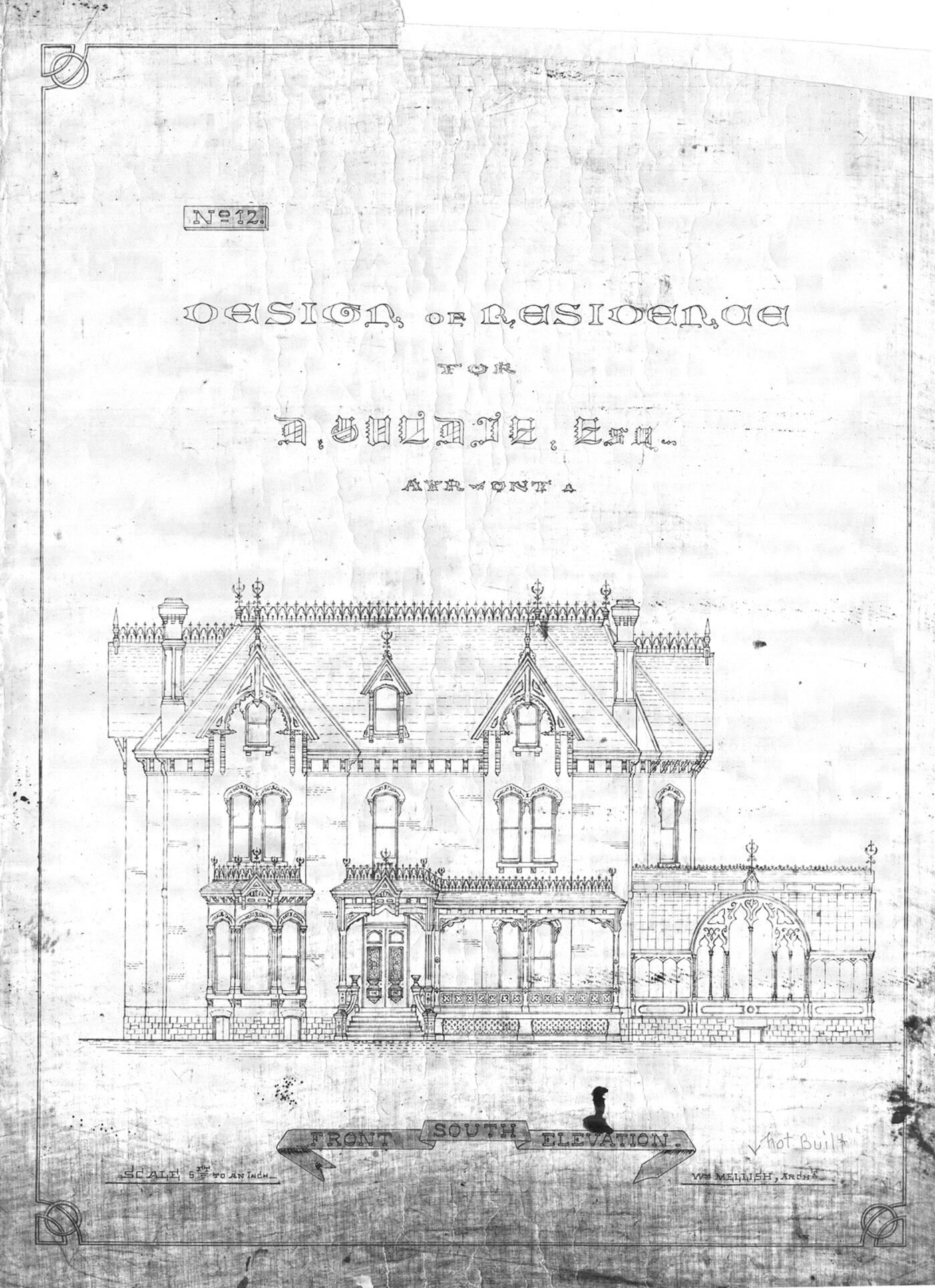
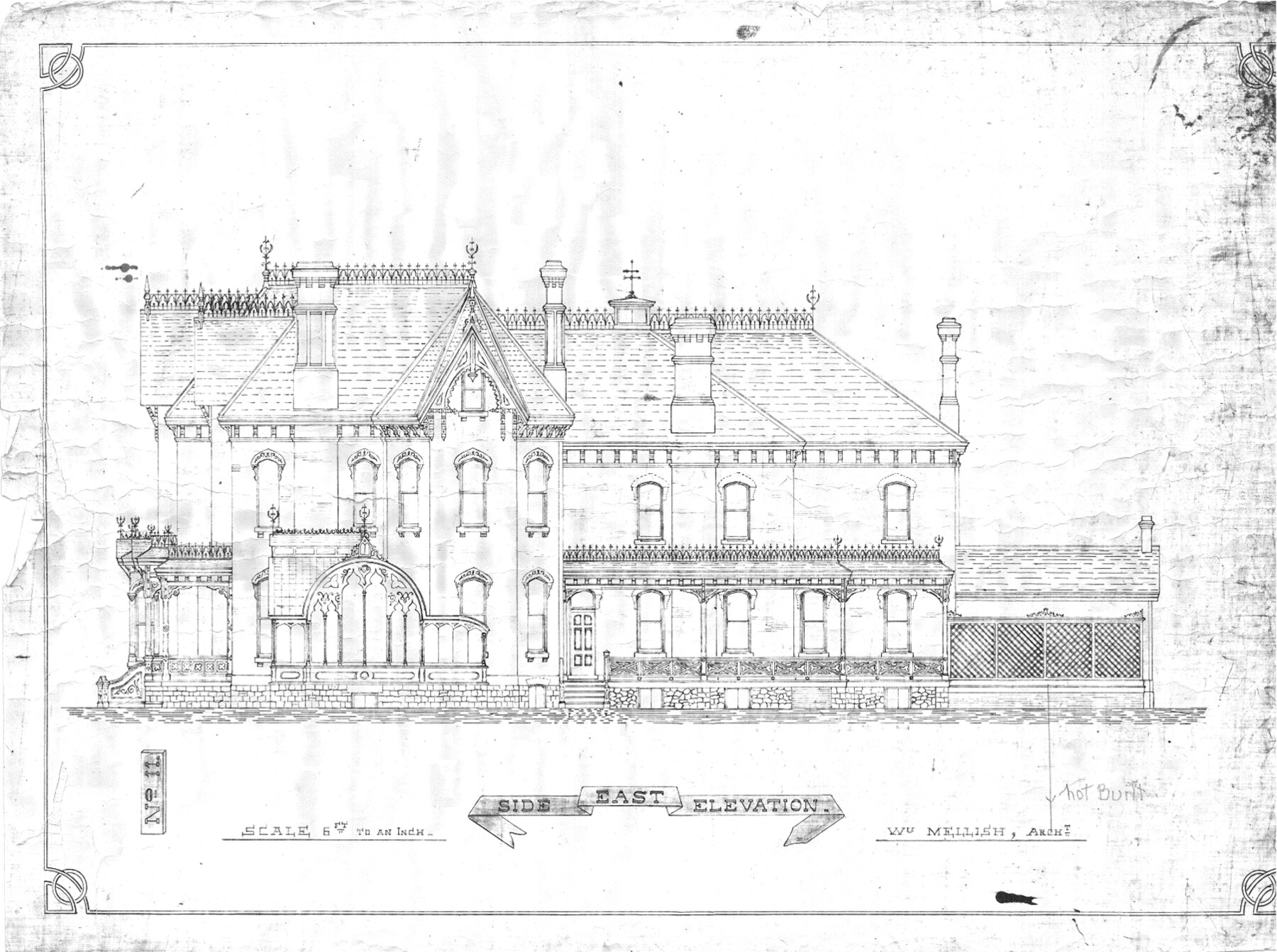
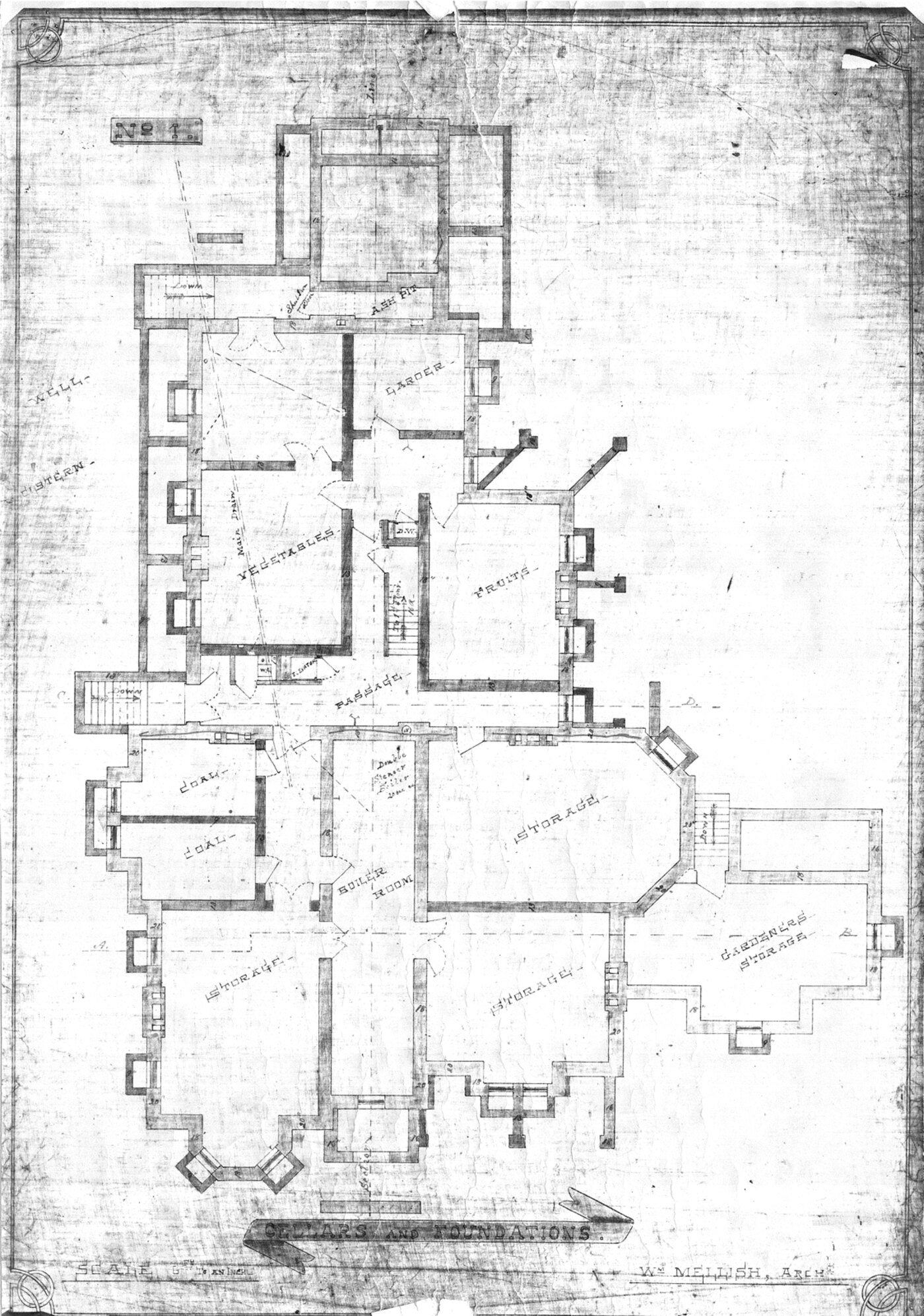
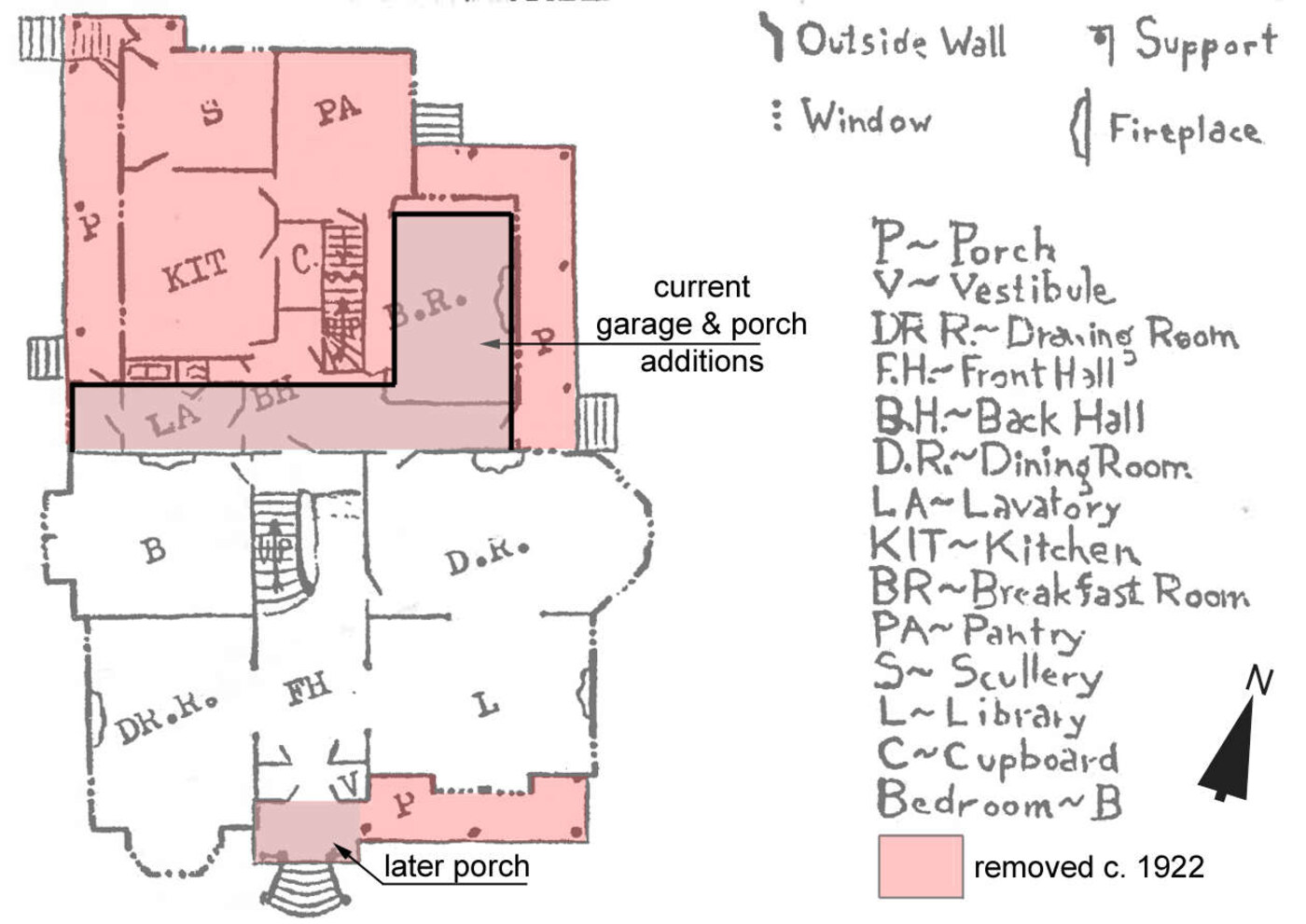
Drawings and plans reproduced from the Cultural Heritage Impact Assessment for 266 & 280 Northumberland Street, Ayr (CHC Limited, July 2017). One drawing is annotated “not built,” so the house as completed varied in places from these presentation sheets.
Step inside
A 360° tour of the lost house
Before the house was erased, its interior was recorded in a set of 360° panoramas — the faded floral wallpaper, the bay windows, the worn pine floors and quiet fireplaces of the home in its final years. Choose a view below, then drag to look around the room. These spheres are preserved and hosted here so they survive even if the originals are ever taken offline.
About these views: the 360° panoramas were captured by William Weston and originally published via Google Street View in July 2018, when the property still stood. They are reproduced here for historical preservation. If you hold the rights and would like a change, the site owner will gladly accommodate.
Hauntings & legends
The rumoured ghost of The Gore
Like many lost Victorian houses, The Gore carries a quiet reputation for being haunted. The story survives mainly as local and family lore — passed along in conversation rather than written down — of footsteps, a presence on the stairs, and a figure said to keep watch from the mansion's widow's walk.
“They say someone never quite left The Gore — that on still nights you could feel the old house was still watching the road.”
Whatever one makes of it, the setting gave the legend everything it needed. A towering 21-room mansion crowned by a widow's walk; the death of its builder, David Goldie, in 1894; the long widowhood of Isabella; and the strange, almost theatrical 1922 reduction, when the upper two storeys were stripped away and the house was left a shadow of itself. A grand home cut down to a bungalow, then erased entirely around 2017 — it is the kind of history that invites a ghost story.
A note on the record: this haunting is presented as legend and oral tradition, not documented fact. No published historical source records a ghost at The Gore, and nothing here should be read as an established claim — only as a piece of local folklore set against the very real history of the house.
A timeline
Two centuries in Ayr
A botanist is born
John Goldie is born in Kirkoswald, Ayrshire, Scotland.
North American expeditions
John Goldie documents fourteen new plant species, including Goldie's fern.
The family settles in Ayr
John Goldie establishes the "Greenfield" farm in Ayr, Ontario.
Greenfield Mill in operation
John Goldie's mill on the Nith River begins grinding grain for the district.
Goldie & McCulloch founded
John Goldie Jr. and Hugh McCulloch buy the Dumfries Foundry in Galt.
"The Gore" is built
David Goldie buys the Northumberland Street land from John Robson (21 June 1883) and raises his 21-room white-brick Italianate mansion — and its coach house — to a William Mellish design.
Goldie & McCulloch incorporates
The Goldie & McCulloch Company Limited is formed on April 21.
David Goldie dies
The estate passes to his widow, Isabella Goldie.
The mansion is reduced
The house is sold and cut down — the upper two storeys and half the ground floor are removed, leaving a single-storey bungalow.
The mansion is lost
The Gore is demolished for the Gore Estate subdivision; the coach house survives.
Heritage protection
The Gore Coach House is designated under the Ontario Heritage Act (By-law 3212-12).